
“We’re getting traffic, but no one is buying our product.”
You’ve seen this before. Maybe you’re living it right now.
You publish blog after blog. Views go up. SEO is doing its job. Clicks come in, and the content calendar looks healthy. The traffic report gets a polite round of applause in the weekly meeting.
It all feels like progress…until you check the pipeline.
Dead. Just as your last quarter’s MQL report.
People read your blog, then bounce. No signup. No demo. No movement. They don’t convert, and they definitely don’t remember you.
This is the trap: treating your blog like a traffic factory instead of a revenue engine.
Only ~2% of B2B SaaS blog visitors convert. That means, if 10,000 people read your blog this month, you’ve missed 9,800 chances to move someone toward your product.
So if traffic is growing but your pipeline isn’t, you’re not alone. It looks productive, but it’s training your future customers to ignore your brand. Traffic is a vanity metric. Conversion is the scoreboard.
And in MarTech SaaS, where the product is complex, the buyer is technical, and the sales cycle isn’t exactly a sprint, this approach doesn’t just waste effort. It tells your audience your product isn’t worth paying attention to.
The good news? It’s fixable. And the bar is low, because most of your competitors aren’t doing it either.
You don’t need more posts to fix this. You need a repeatable content system that turns real buyer pain into product-qualified leads. You need a Blog-Idea Engine.
The Blog-Idea Engine isn’t a one-time fix. It’s a repeatable system you can return to every quarter to realign your content with real buyer pain, product movement, and revenue outcomes.
But before we talk solutions, let’s look at the real reason your blog isn’t converting.
Table of Contents
ToggleWhy most MarTech SaaS blogs fail (even when traffic looks good)
Most SaaS blogs follow a rinse-and-repeat playbook (and end up making the same blogging mistakes that cost them leads):
- Run keyword research
- Publish 10 posts per month
- Track traffic in GA
- Call it content marketing
But here’s the kicker: more posts ≠ more customers. Too often, teams chase rankings rather than conversions, education, or sales.
And while that approach can win you some SEO rankings and vanity metrics, it does almost nothing for:
- Lead quality
- Demo or trial conversions
- Product adoption
- Customer expansion or retention
You know what you end up with? A blog that looks busy, but doesn’t drive the business forward. But, if it doesn’t help someone say ‘yes,’ it’s not content that’ll convert, it’s just another tab they’ll close before they even remember your name.
Ask yourself:
- Of all the content you’ve published in the last quarter… how much of it helped a user say “yes” to your product?
- How many blog readers entered a trial, booked a demo, or even remembered your brand 30 minutes later?
- How many of your posts reflect your actual buyer journey, not just chase whatever Clearscope says ranks?
If the answers make you uncomfortable, that’s the real problem. Because at that point, it’s not a blog strategy, it’s roulette.
It’s time to stop publishing for publishing’s sake and start building a system that earns its keep. Instead of chasing traffic, build for trust. Build for momentum.
So how do you stop filling the content calendar and start creating content that actually converts?
The shift: From blog calendar to Blog-Idea Engine
You don’t need more posts. You need better ideas and a system that turns those ideas into content with a job. Because content with a job does what traffic can’t: it drives a product-qualified pipeline.
What you want is a Blog-Idea Engine — a content system designed to move users through their buyer journey, aligned with your product value, built around intent, not volume.
The Blog-Idea Engine shifts your mindset from volume to velocity.
It’s not about publishing more. It’s about publishing with purpose.
Most MarTech SaaS teams think in terms of: “How many posts should we publish this month?”
The Blog-Idea engine asks: “What pain are we solving, and what’s the next step for the reader?”
Here’s an example:
Old approach:
- Write “Top MarTech Trends in 2025”
- Track traffic
- Hope they convert
New approach:
- Write “Why your reporting stack breaks at scale, and what to do about it”
- Track product movement
- Guide the reader toward a trial, demo, or signup
When you switch from chasing clicks to solving problems, your content stops being a to-do item and starts being a growth driver.
Build this engine, and watch your content shift from a marketing task to a growth asset.
Let’s break it down: What this engine really looks like
This isn’t a fancy name for “strategic blogging.” It’s an engine that transforms raw buyer pain into product-qualified pipeline — on repeat.
Here’s how it works and why it works.
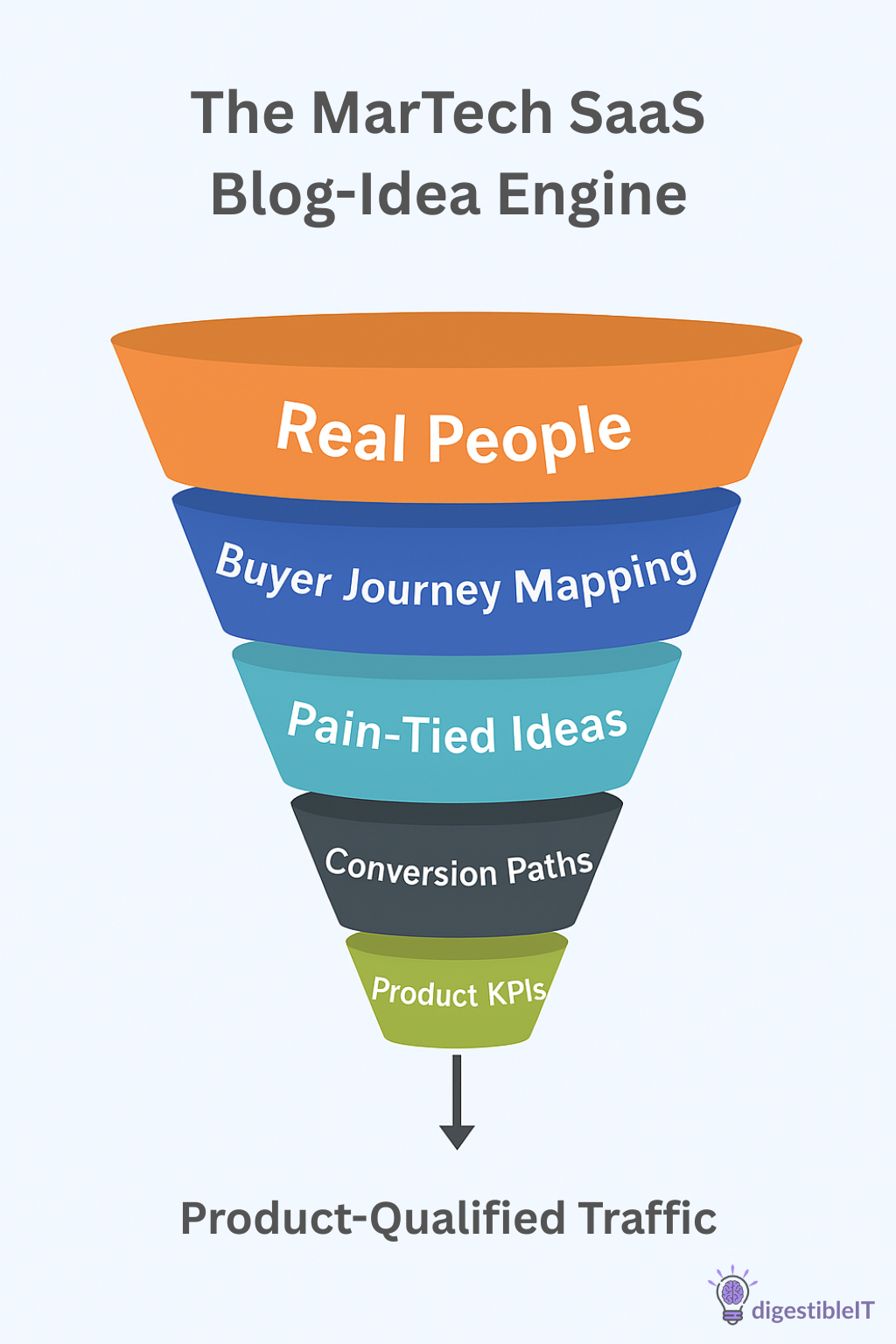
The Blog-Idea Engine is built on five levers:
- Real people,
- Buyer journey mapping,
- Pain-tied ideas,
- Conversion paths, and
- Product KPIs.
Pull all five, and you create content that converts.
Think of it like a 5-cylinder engine. Each part fires in sequence to create forward motion and real growth. Each layer fuels the next, turning raw buyer pain into product-warmed traffic.
Let’s break down the five levers and see how to apply them to your MarTech SaaS blog strategy.
Lever 1: Start with real people, not just personas
Who are you really writing for?
Not a vague “marketer.” Not “someone in SaaS.” Specific roles. Tangible problems. Human friction. Because writing for actual people leads to meaningful results.
For MarTech SaaS, that might be:
- Marketing Ops Managers juggling 9 tools and 12 dashboards
- Growth Leads proving ROI to skeptical CFOs
- Demand Gen teams who need clean data to build solid campaigns
Now ask:
- What frustrates them daily?
- Where do they waste time or money?
- How does your product actually solve those pains, and where might it fall short?
Vague personas lead to vague content. Real people lead to real results.
Next time you brainstorm content, skip the search bar. Start with a customer call transcript. Or pull up five win/loss recordings and highlight the exact phrases your buyers use when they’re frustrated, stuck, or actively looking for a solution. That’s your content fuel. Start with a customer quote, not a keyword.
Once you know who you’re writing for, the next step is knowing where they are. Because what they care about depends on what stage they’re in.
Lever 2: Map their journey, not just their job
MarTech buyers don’t just read one blog post and convert; they take their time (and you know this). They compare tools, validate options, and get input from peers. Your content should guide them through each stage.
So map your blog to that reality:
Stage | What They’re Thinking |
Awareness | “This process is painful, but I’m not sure why.” |
Consideration | “There has to be a better way — what tools solve this?” |
Decision | “Is this tool worth the switch? Will it actually work?” |
Adoption | “How do I get value fast and prove to my team this was the right choice?” |
Expansion | “How else can this help my team hit goals?” |
Fail to guide your readers, and your content floats — disconnected and forgettable.
This isn’t just a nice theory. Use it to audit your content and tag each post by funnel stage.
For example, you might tag your last 25 posts and discover that 60% are Awareness, 30% are Consideration, and only 10% support Decision-stage buyers. That leaves your high-intent audience with nothing to act on, and explains the conversion gap.
Create a simple spreadsheet. One column for the funnel stage. One for CTA. One for intent. Score each post’s job.
This isn’t busywork; it’s your blueprint for moving readers from lurkers to leads.
Now that you’ve mapped the path your buyer takes, it’s time to figure out what actually gets them moving, and that starts with pain.
Lever 3: Generate ideas that tie pain to product
Here’s where most MarTech SaaS blogs go wrong — they disconnect content ideas from actual product value.
Most teams chase high-volume keywords that sound strategic, but don’t map to buyer pain.
Next time, instead of writing “Top 10 Marketing KPIs,” try:
- “Why manual reporting is draining your team’s time and how to fix it”
- “How one agency cut reporting time by 60% and kept clients longer”
- “7 questions to ask before picking a marketing analytics platform (that nobody tells you)”
These don’t just sound better. They perform better because they:
- Tap into real buyer pain
- Introduce your product naturally
- Create motivation to take the next step
That’s what content should do, not just drive traffic, but move buyers toward trials, demos, and signups.
SEO tools are great for reach. But reach without relevance is just noise. Buyers give you pain. That’s what drives action. Build content from that.
Instead of starting with high-volume keywords, start with high-friction pain points.
Once you’ve got a real pain to solve, use a structured blog outline to build momentum and lead them toward your product. Your customers don’t search for “MarTech KPIs”; they search for “how to stop wasting 10 hours a week in spreadsheets.”
Talk to your CS team. Ask: Where do users get stuck? What do they complain about? What gets escalated? That’s your idea goldmine. Your buyers don’t need another listicle. They need a way out of their pain. Give it to them.
If your next post doesn’t relieve a real pain, it’s not an idea — it’s a placeholder.
But an idea, even a good one, isn’t enough. Now you need to give it momentum, to guide the reader from pain to product.
Lever 4: Turn each post into a conversion path
Your blog isn’t a library. It’s a guided experience.
Think of it like a museum. You don’t just hang art. You design the visitor path. The lighting matters. The signs matter. What people see first and where you take them next changes the whole experience.
Your blog should do the same, especially when you’re creating content with a job to do.
Once you’ve got an idea that ties directly to buyer pain and maps to a real funnel stage, the next step is simple: give it somewhere to go.
Because even the most valuable blog post loses momentum when it sits in isolation. It might speak to a problem. It might even connect to your product. But if it leaves the reader wondering, “Okay, now what?”, the engine stalls.
Content that converts is content that moves.
Use CTAs, internal links, and content clusters that lead your reader forward from “I have this problem” to “this product can actually help me solve it.” Also, don’t underestimate how smart formatting makes that next step clearer and more clickable.
Let’s say you write a Consideration post on “Manual vs. automated reporting.” Midway through the post, embed a CTA block that says:
“Manually building reports? Try automating it with [Your Tool] — start your free trial in under 60 seconds.”
Tag the CTA with a UTM link to track if readers from this post are actually starting trials.
Then, at the end of the post, link to your Decision-stage guide: “7 questions to ask before choosing a reporting tool.”
Sprinkle in onboarding tips, advanced features, and customer stories along the way. Now your blog is doing what your SDRs wish they could: warming up leads 24/7.
This is where your blog-idea engine starts to build momentum — when one strong, pain-tied post doesn’t end the journey… it fuels the next step.
Skim your last 5 posts. Could a reader find their way to a demo from each one? Could they understand how your product actually solves the pain you described?
If the answer’s no, then all that traffic it’s just a distraction dressed up as progress.
Your content isn’t a pile of assets. It’s a system. And systems need motion. So build a path, not just a post.
Your content is now guiding readers, but is it working? It’s time to look past pageviews and track what really matters: product movement.
Lever 5: Track KPIs that drive product movement, not just rankings
Traffic is easy. Product movement is hard.
But if your blog’s goal is trial signups, demos, or feature adoption, those are the KPIs you need to track, not just sessions or rankings.
Too many teams stop at vanity metrics. They measure clicks, not outcomes. But if you want to prove that content drives revenue, you need to tie it directly to product behavior.
Here are the KPIs that actually matter for a MarTech SaaS blog:
- Trial signups influenced by blog CTAs
- Demo requests sourced or assisted by content
- Activation rate from post-click blog traffic
- Feature adoption from onboarding content
- Churn reduction after publishing support content
- Expansion revenue influenced by product-led educational content
It’s not always clean or easy. But here’s what you can do today:
- Add UTM parameters to every CTA. Track which content actually drives product action.
- Use attribution tools to see which pages show up in high-value journeys.
- Tag every blog post by funnel stage and intent, so you can track which stages actually influence the pipeline.
When you track KPIs like these, you stop asking, “Did it rank?” and start asking, “Did it help someone say yes?”
That’s what separates a traffic blog from a conversion engine. When you measure product movement, you stop marketing in the dark.
And if you think the Blog-Idea Engine only applies to BOFU posts, you’re leaving way too much on the table.
Yes, even TOFU content should point to your product
If you’re thinking, “This is great for bottom-of-funnel content, but what about our TOFU stuff?”, you’re not wrong to ask.
But here’s the thing: this SaaS content strategy works at every stage of the funnel, including the top.
In product-led SaaS, every piece of content is an opportunity to create product awareness, trust, and relevance, even if it doesn’t end with a demo button.
Even in TOFU content, you can (and should) connect the dots to your product.
Too many MarTech SaaS blogs still follow the outdated TOFU–MOFU–BOFU framework like it’s a checklist. But in a product-led SaaS, every piece of content is an opportunity to show how your product solves a specific, painful problem.
That doesn’t mean every blog should pitch a free trial. It means that even your top-of-funnel ideas, the ones about strategy, mistakes, and trends, can still naturally guide the reader toward your product’s value.
Take Semrush’s guide on how to run a content audit.
It’s a classic TOFU piece — educational, useful, step-by-step. But scattered throughout are subtle, product-led moments: showing you how to do it manually, then how their tool makes it 10x faster.
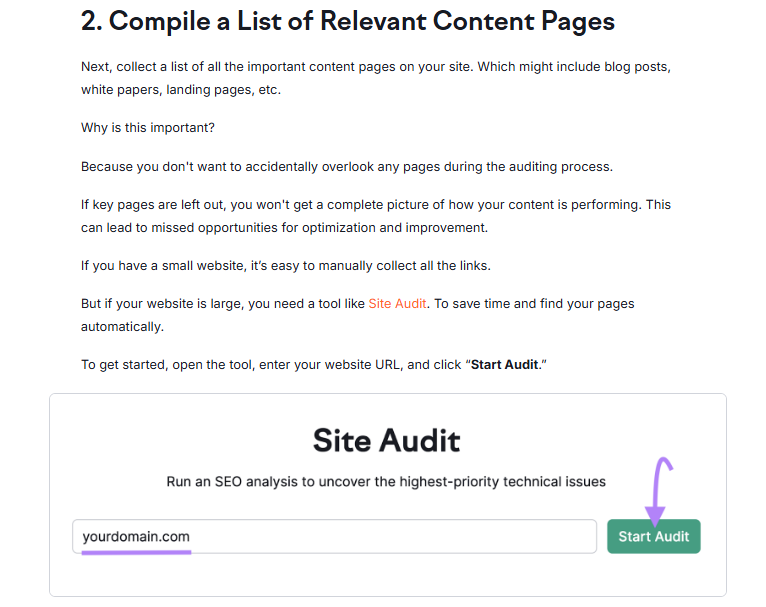
No hard CTAs or aggressive sales pitch. Just smart, embedded relevance: “Here’s how you do it manually. Now here’s how our product makes it 10x easier.”
That’s product-led TOFU done right.
Here’s how to make it sharper in your own content:
- Generic version: “How to Perform a Content Audit” — ends with a checklist and links to other blogs
- Product-led version: Same post, but with tool screenshots, in-context prompts, and a smart CTA like: “Want to skip the manual work? Run your first audit with [Your Tool] — no credit card required.”
TOFU content can still generate product curiosity if you use it to show, not just tell.
If your TOFU piece solves a real problem, then your product should be part of the solution, even if it’s just a supporting actor. That’s how you turn content into a product experience, not just a blog post.
So yes, use this Blog-Idea Engine to power your conversion content. But don’t stop there. Use it to make every post, even TOFU, part of the buying journey.
If a reader learns something useful but still doesn’t connect it to your product, your blog is doing free labor for someone else’s funnel.
What this looks like in action: A MarTech SaaS example
To see this engine in action, here’s how a MarTech SaaS blog might map content to funnel stages, each tied to a specific buyer pain.
Let’s say you run a reporting automation tool for marketing teams.
Here’s what a content engine might produce:
Funnel Stage | Blog Idea |
Awareness | “Why manual reporting is costing your team 20+ hours a month.” — frames the time cost (pain) |
Consideration | “Manual reports vs. analytics platforms: what actually gives better ROI?” — compares alternatives (value) |
Decision | “7 questions to ask before choosing a reporting tool (and what to avoid)” — guides decision (activation path) |
Adoption | “Your first 30 days: how to hit time-to-value faster with automated reporting.” — removes friction (adoption) |
Expansion | “5 advanced reporting workflows to expand your impact and make execs happy.” — reinforces value (expansion) |
Each piece speaks to a real problem, connects to product value, and moves the reader forward.
If you can’t tie your product directly into each one (with either screenshots, feature callouts, or use cases), you’re leaving trust and conversions on the table.
Plug your product into this table. Fill in your own version by Friday. Then walk it into your CEO’s office and show what a real SaaS content strategy looks like.
And, if this map makes you nervous, good. Fix it before your pipeline pays the price.
One post per funnel stage. One pain per post. That’s how you stack momentum.
Ready to get out of content purgatory? Here’s how to fire up your engine.
Getting started: The first 30 days of your Blog-Idea Engine
You don’t need to rebuild everything. Just start smart with small changes.
Here’s a 30-day roadmap you can use:
- Week 1 (Lever 1: Real People): Talk to real users. Interview your best-fit customers. Note what they say, where they get stuck, and what frustrates them.
- Week 2 (Lever 2: Buyer Journey): Map their journey. Tag your top 25 posts by funnel stage and intent. Find the gaps.
- Week 3 (Lever 3: Pain-Tied Ideas): Brainstorm 10 ideas tied to pain + product, not just keywords.
- Week 4 (Levers 4–5: Conversion Paths + KPIs): Publish one high-quality, funnel-specific, product-led post that guides the reader from pain to product. Include a clear CTA (trial, demo, or deeper engagement), and tag it with UTM links so you can track what actually drives product movement.
Then measure:
- Did it attract the right reader?
- Did they convert, subscribe, or take action?
- What’s the next step they should take, and does your content lead them there?
One strategic post that converts is worth more than a hundred that just fill space.
I’ve seen this firsthand.
When I was working at an agency, we proved this works with a single decision-stage post that addressed reporting pain directly. It drove 23 demo signups for our ECM SaaS client in just 30 days — more than the previous 10 traffic-focused posts combined.
Great content doesn’t come from volume but from intention, relevance, and timing. Make your blog your best-performing salesperson.
Do it once, and you’ll see what’s possible. Do it consistently, and you’ll change how your company thinks about content.
Let’s digest it: Build your engine. Prove what content can do
Your blog doesn’t need to be louder. It needs to be smarter.
Traffic isn’t the enemy — unqualified, unmotivated traffic is.
Volume isn’t the problem — volume without intent is.
When you build a Blog-Idea Engine:
- Every post has a job
- Every idea speaks to pain
- Every piece moves a reader forward
You stop guessing. You stop spamming. You start building content that earns trust and drives growth. Fewer posts. Sharper ideas. Better outcomes.
You’ve done the hard work of getting traffic. Now make it count. Pick one post this week. One real buyer pain. One funnel stage. Build it. Tag it. Publish it with purpose. That’s your first engine run.
Then go one step further. Share this blog-idea framework with your team. Set your team’s 90-day mission: Every post earns its place, driving progress in your funnel and clarity in your strategy. Review monthly. Measure impact. Report wins.
This is how you turn content into a pipeline driver. Build your engine, then prove what content can really do.
Content should be your best-performing salesperson, not your most expensive hobby.

Ema is a writer, editor, and content strategist with 10+ years of experience. She helps brands turn vague traffic goals into content that connects, not just ranks.